Guide · Directive (EU) 2023/970 and L.N. 173 of 2026
EU pay transparency: employer duties and deadlines
The Directive applies across the EU from 7 June 2026, and Malta has made it law. Here's who it covers, what it asks of every employer, how the gap report and the 5% rule work, and Malta's own deadlines, with the article for every point.
- 7 June 2027
- First gap reports, from 150 workers
- 8 days
- To answer a pay request in Malta
- 5%
- Gap in a category that can lead to a joint pay assessment
Who is covered
Every employer in the public and private sector, and every worker with an employment contract or relationship. Job applicants are covered by the rules on hiring. Most duties apply at any size. The gender pay gap report starts at 100 workers, on dates set by headcount.
| Workers | First report | Then |
|---|---|---|
| 250 or more | 7 June 2027, on 2026 | Every year |
| 150 to 249 | 7 June 2027, on 2026 | Every three years |
| 100 to 149 | 7 June 2031, on 2030 | Every three years |
| Fewer than 100 | Voluntary | |
Article 9(2) to 9(5); Malta, regulation 9(2) to 9(6).
Duties for every employer
Four duties apply from the first employee. They're the ones most often missed, because they come before any report.
Pay ranges before hiring
Applicants learn the starting pay or its range before the recruitment process ends, and you can't ask what they earn now or earned before. Job adverts and titles are gender-neutral.
Article 5; Malta, reg. 4
Written pay policy
Write down the criteria that set pay, pay levels and progression, and keep them available to workers. Below 50 workers, progression criteria can be exempt; in Malta, from 25 workers they're still documented internally.
Article 6; Malta, reg. 5
Pay requests
Any worker can ask for their own pay level and the average pay of women and men doing the same work or work of equal value. The Directive allows up to two months. Malta allows eight days.
Article 7; Malta, reg. 6
Yearly notice to workers
Once a year, every worker hears that they can ask for pay information and how to do it. Workers are free to disclose their own pay to enforce equal pay.
Article 7(3); Malta, reg. 6(6)
Malta: eight days to answer a pay request
L.N. 173 of 2026, the Equal Pay (Transparency and Reporting) Regulations, 2026, follows the Directive with one big change: a written answer to a pay request is due in eight days, where the Directive allows up to two months.
If it doesn't come, an employees' representative or the worker's union can ask on their behalf within twelve more days, and then the worker can go through the Equality Body. If the information still hasn't been provided 45 days after the first request, the failure is an offence and the Director can start proceedings.
Keep the data behind every answer for at least five years. The Monitoring Body is the Department for Industrial and Employment Relations; the Equality Body is the National Commission for the Promotion of Equality.
The gap report: seven indicators
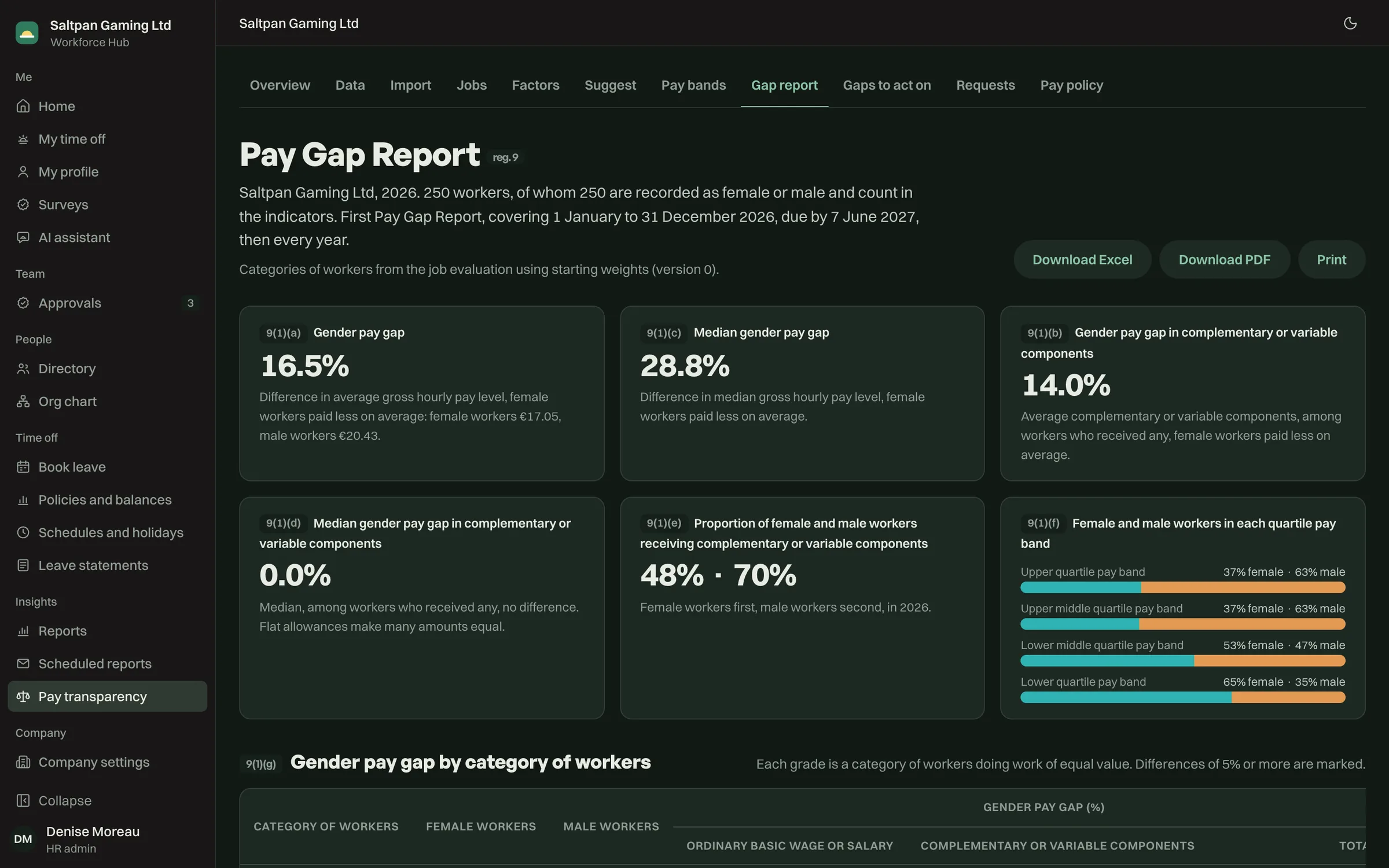
Employers with 100 or more workers report seven figures. Pay means gross annual and hourly pay, with every complementary and variable component: bonuses, commission, allowances and benefits in kind.
- The gender pay gap
- The gap in complementary or variable pay
- The median gender pay gap
- The median gap in complementary or variable pay
- The share of women and men receiving variable pay
- The share of women and men in each pay quartile
- The gap by category of workers, basic and variable pay
Management confirms the report after consulting employees' representatives. The full report goes to the monitoring body; indicator (g) goes to every worker.
Article 9(1), 9(6), 9(7); Malta, regulation 9(1), 9(7) to 9(9).
The 5% rule and the joint pay assessment
A joint pay assessment with your employees' representatives is required when three things are true at once: the report shows a gap of at least 5% between women and men in a category of workers, you haven't justified it on objective, gender-neutral criteria, and you haven't fixed it within six months of submitting the report.
The assessment covers the make-up of each category, average pay, the differences and their reasons, pay rises after family leave, the measures to close unjustified gaps, and how earlier measures worked. In Malta it goes to the Monitoring Body within ten working days of being finished.
Proof, compensation and fines
The law moves the risk onto the employer. A record of every decision is the best defence.
Burden of proof
Once a worker shows facts that suggest pay discrimination, the employer has to prove there wasn't any. Missing transparency duties counts against you.
Article 18; Malta, regulation 15
Compensation
Workers can recover back pay, related bonuses and payments in kind, and damages. Claims can be brought for at least three years.
Articles 16 and 21; Malta, regulations 14 and 16
Fines up to €7,000 in Malta
€2,500 to €5,000 for a breach, and €5,000 to €7,000 where it involves equal pay for work of equal value. Repeat breaches draw more.
Article 23; Malta, regulation 20
How Squadra HR handles each duty
The pay transparency module works from the records you already keep in Squadra HR, or from a file exported from your current HR system.
| What the law asks | What Squadra HR does |
|---|---|
| Gender-neutral criteria for work of equal value (Art. 4; reg. 3) | Every role scored on skills, effort, responsibility and working conditions, with sub-factors you can rename, add or retire, soft skills included. Weights are saved as versions, each with a reason. |
| Pay ranges before hiring (Art. 5; reg. 4) | A pay band per grade, listed on the pay policy page, ready to put in an advert. |
| Pay setting and progression criteria (Art. 6; reg. 5) | A pay policy page with the factors, weights, grades, ranges and progression rules, to share with workers. |
| Pay requests (Art. 7; reg. 6) | Log a request and the due date follows your governing law: eight days in Malta, two months elsewhere. The answer is drafted from the same figures as the report, yearly and hourly, on a full-time basis. |
| The seven indicators (Art. 9; reg. 9) | Indicators (a) to (g) worked out from your pay data, part-time pay on a full-time basis, with Excel and PDF export for the monitoring body. |
| Reporting dates (Art. 9; reg. 9) | Your first report date and frequency, set from your headcount. |
| Management sign-off (Art. 9(6); reg. 9(7)) | A confirmation block on the PDF and the Excel export, for the date, name, role and signature. |
| The 5% rule (Art. 10; reg. 10) | Every category with a gap of 5% or more flagged, with the six-month date and HR's recorded decision. |
| Joint pay assessment (Art. 10(2); reg. 10(2)) | A draft per flagged category, filled in from the figures and HR's decisions. |
| Small groups (Art. 12) | A warning wherever a category is small enough for an average to reveal one person's pay. |
| Burden of proof (Art. 18; reg. 15) | Every decision, answer, import and export in an append-only activity log, with who and when. |
A checklist for 2027
Seven steps, in the order that saves the most time. Start with the job evaluation: everything else follows from it.
- Count your workers and find your first report date.
- Score every role on the four criteria and group roles into grades.
- Set one pay band per grade and use it in job adverts.
- Write the pay policy down and make it available to workers.
- Send this year's notice of the right to pay information.
- Be able to answer a pay request in eight days.
- Run the gap report on 2026 data now, and decide every 5% gap.
Questions
Does the EU pay transparency law apply to small companies?
Yes. Every employer must give pay ranges before hiring, keep pay criteria available to workers, answer pay requests and tell workers about that right each year. Only the gap report depends on size: it's required from 100 workers.
When is the first gender pay gap report due?
Employers with 150 or more workers report by 7 June 2027, on 2026 data. Employers with 100 to 149 workers report by 7 June 2031, on 2030 data. Below 100, reporting is voluntary.
How long do we have to answer a pay request in Malta?
Eight days, in writing, under regulation 6(2) of L.N. 173 of 2026. If the information still hasn't been provided 45 days after the first request, that failure is an offence.
What happens if our gap is 5% or more?
If a category of workers shows a gap of 5% or more that you can't justify on objective, gender-neutral criteria and haven't fixed within six months of submitting the report, you run a joint pay assessment with your employees' representatives.
Do we need a licensed job evaluation method?
No. The law sets four criteria, skills, effort, responsibility and working conditions, and requires them to be applied in a gender-neutral way. The method is yours to choose.
What are the fines in Malta?
€2,500 to €5,000 for a breach of the regulations, and €5,000 to €7,000 where it involves a breach of equal pay for equal work or work of equal value, under regulation 20. Lost pay and compensation come on top.
Further reading
- What Malta's L.N. 173 of 2026 means for employersThe eight-day answer rule, the reporting dates, the 5% rule and the fines, in the order an employer meets them.
- The 5% rule and joint pay assessmentsWhen a gap in one category of workers turns into a formal assessment with your employees' representatives, and how to stay ahead of it.
- Job evaluation without HayThe law asks for gender-neutral criteria. It doesn't ask for a licensed method. Here's how to build your own and defend it.
Sources: Directive (EU) 2023/970, EUR-Lex; L.N. 173 of 2026, legislation.mt.
Answer pay requests in eight days
We set up the job evaluation, grades and bands with you, from your current HR data, and your first gap report is ready the same day.