

Pay transparency
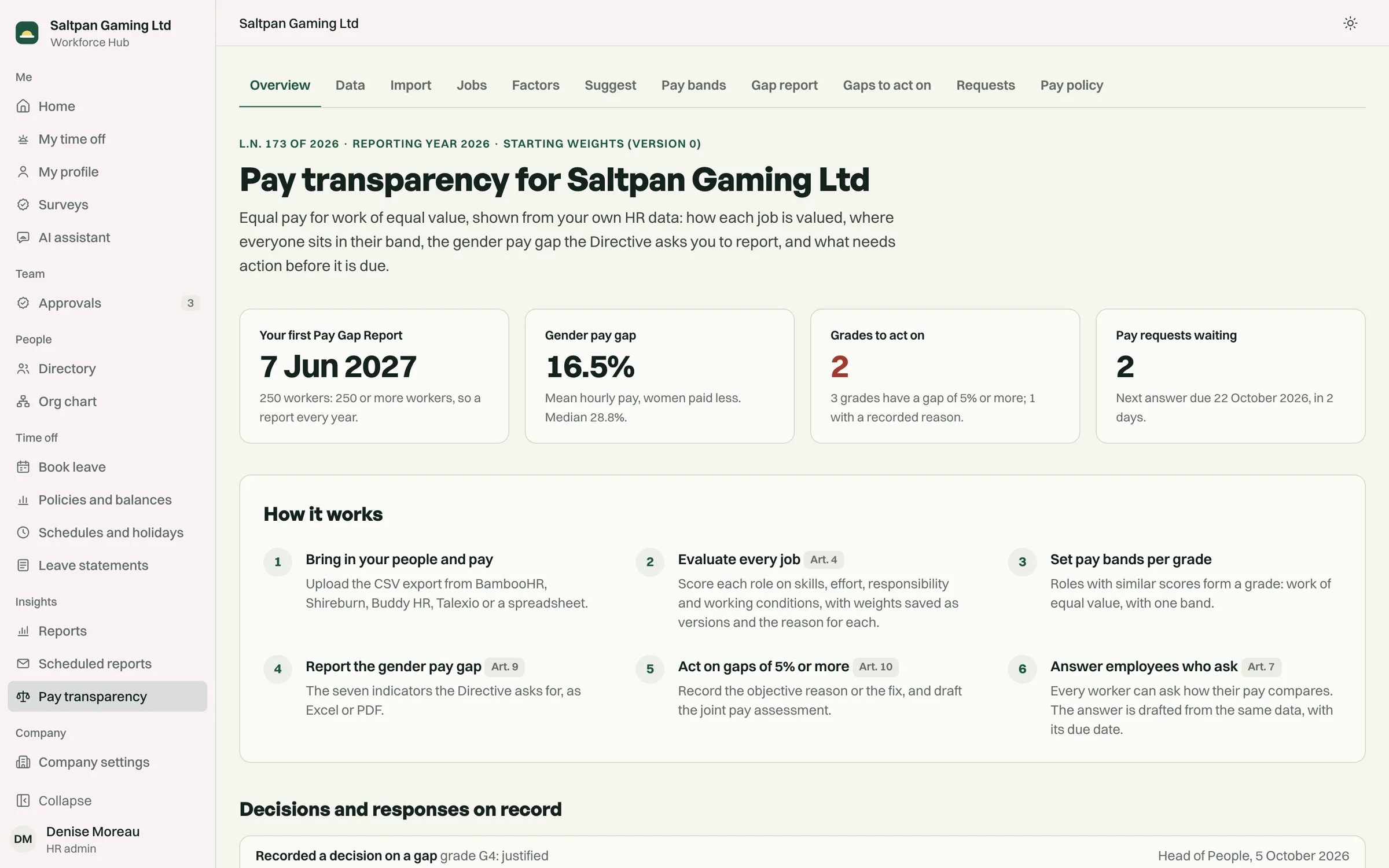
How the module covers the EU Pay Transparency Directive and Malta's L.N. 173 of 2026: job evaluation, pay bands, the gap report, gaps to act on, pay requests.
The module works out what Directive (EU) 2023/970 asks of an employer from the people, job and pay data already in the system. Only HR can open it, and every view is written to the audit log.
It works out the figures, flags what needs a decision and drafts the documents, so HR spends its time on the decisions.
Getting the data in
Section titled “Getting the data in”The module reads each person’s job, grade, base pay, variable pay, hours and gender from their record. Import takes a CSV export from another HR or payroll system, with a column-mapping preview before anything is saved.
Job evaluation
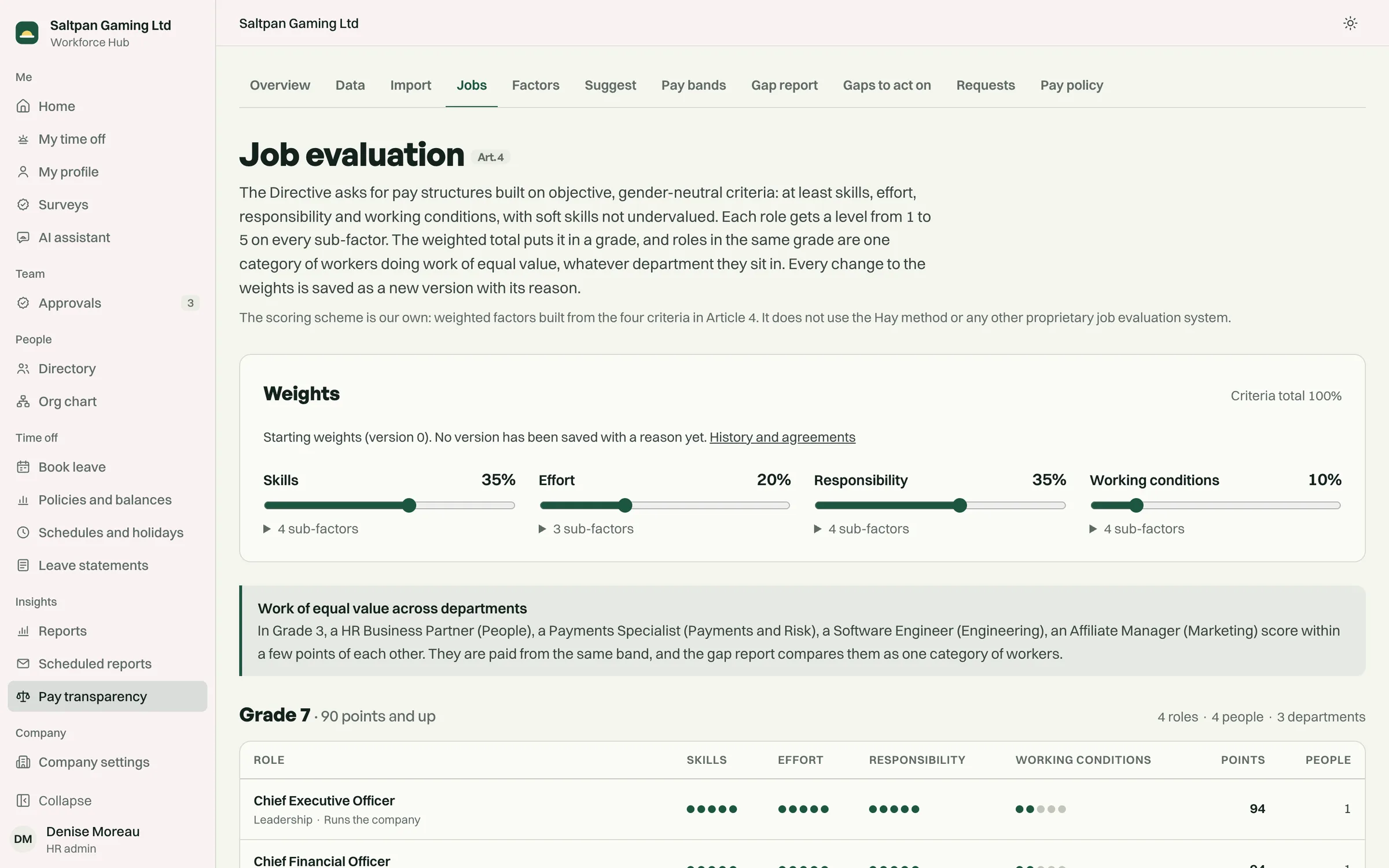
Section titled “Job evaluation”Each role gets a level from 1 to 5 on the four factors in Article 4(4): skills, effort, responsibility and working conditions. The skills factor includes people skills such as communication and care.
The levels are weighted (35, 20, 35 and 10 percent by default) and added up. The total puts the role in a grade, and roles in the same grade count as work of equal value across departments. The weights can be tried on screen to see how grades would move.
The scheme is a weighted-factor method built from the four criteria. It doesn’t use the Hay method or any other proprietary system.
Pay bands
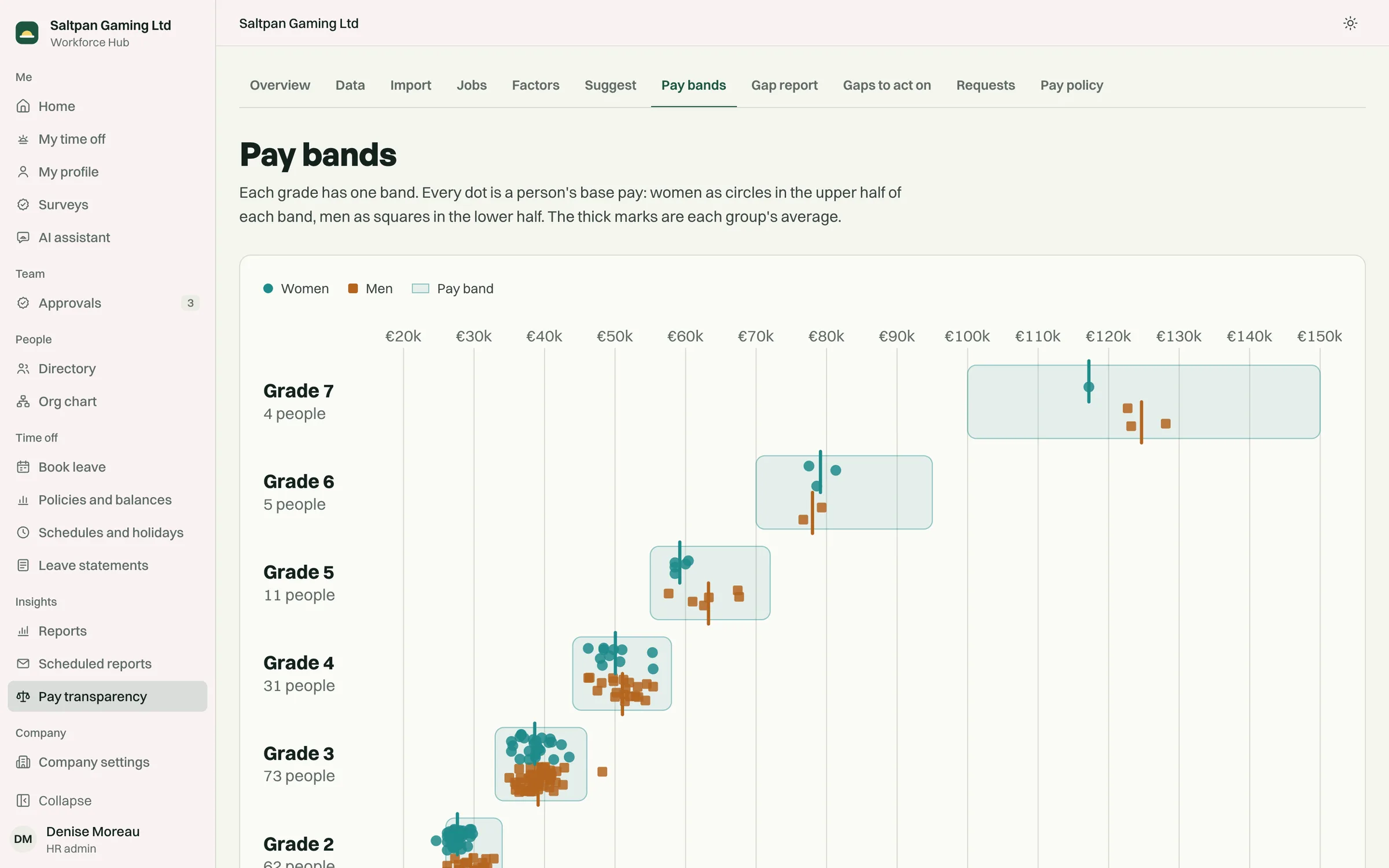
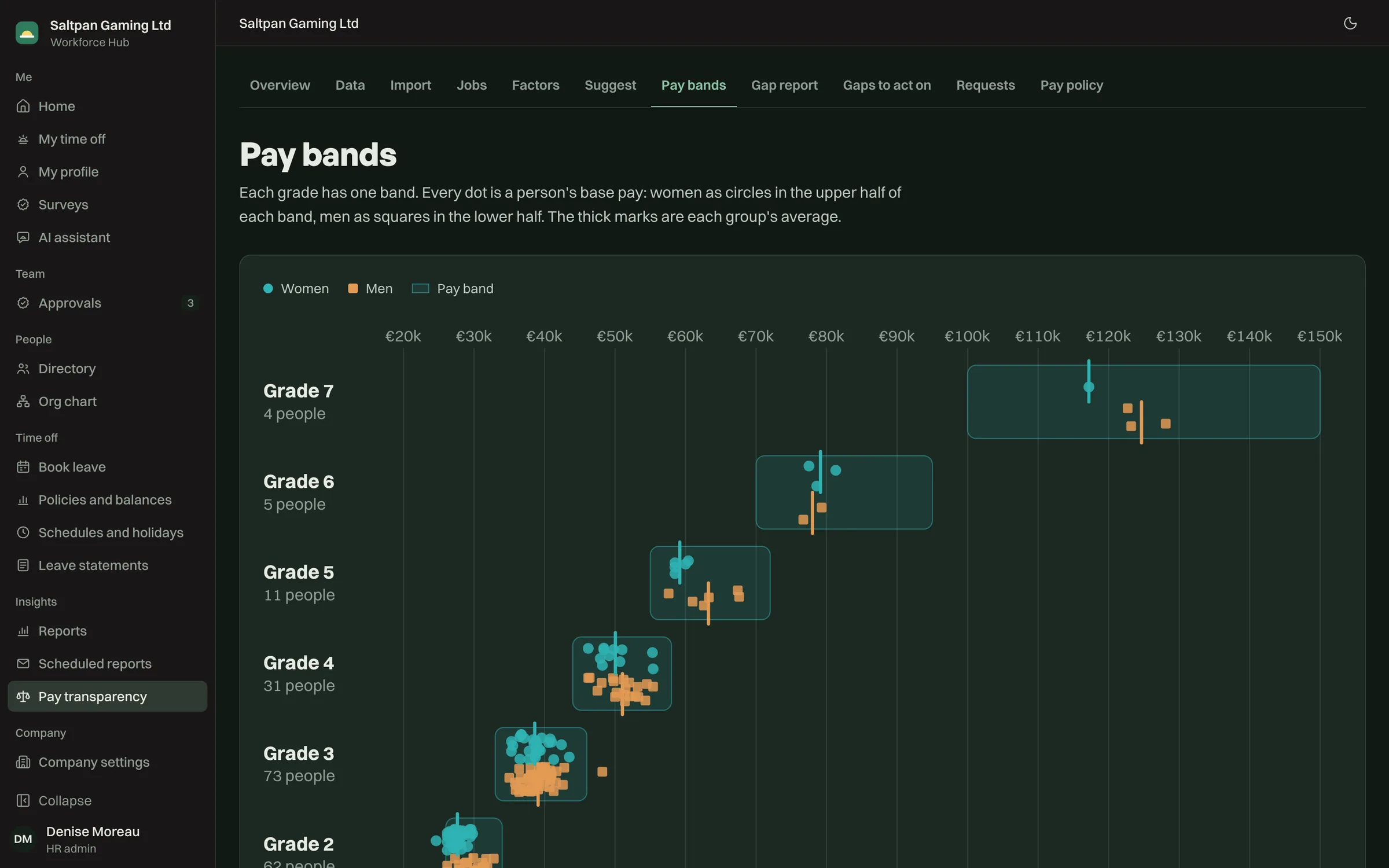
Section titled “Pay bands”Each grade has one pay band. Pay bands plots everyone’s base pay against their grade’s band, women and men apart, with each group’s average marked. People outside their band are listed.
The gap report
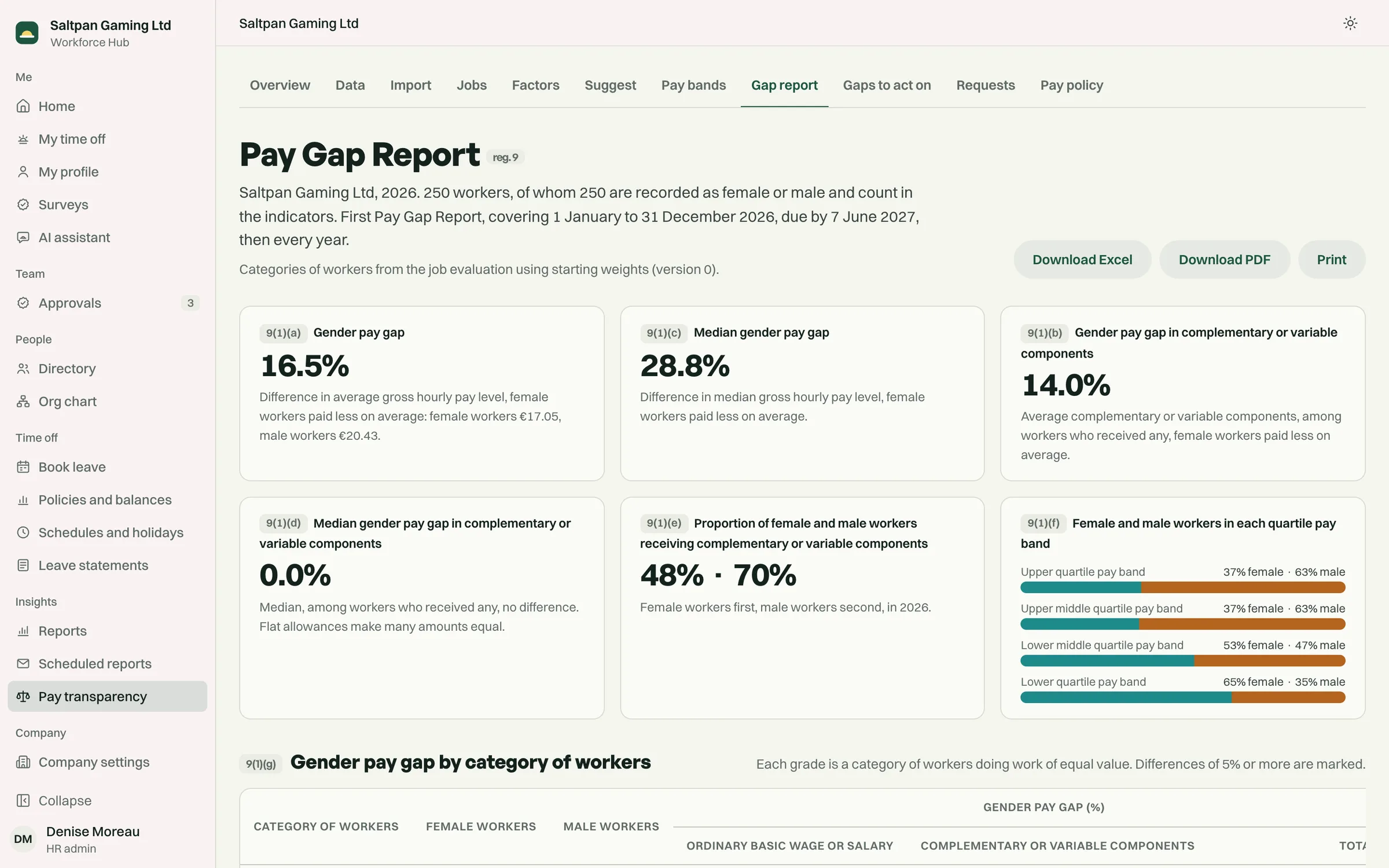
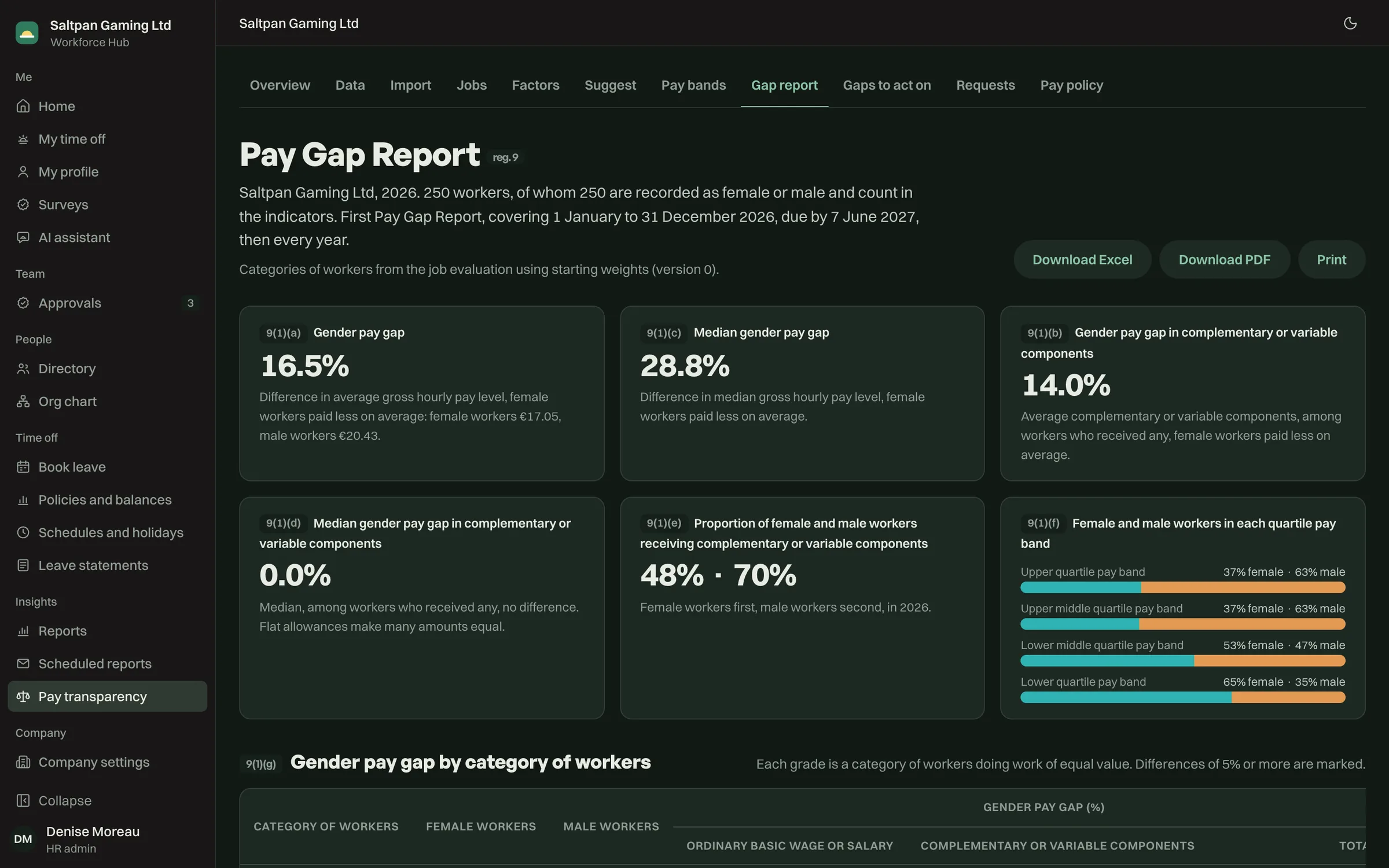
Section titled “The gap report”Gap report works out the seven indicators of Article 9(1):
| Indicator | What it measures |
|---|---|
| (a) | Mean gender pay gap |
| (b) | Mean gap in complementary or variable pay |
| (c) | Median gender pay gap |
| (d) | Median gap in complementary or variable pay |
| (e) | Share of women and of men receiving complementary or variable pay |
| (f) | Share of women and men in each pay quartile |
| (g) | Gap by category of workers, split into basic and variable pay |
How the figures are worked out:
- The gap is men’s figure minus women’s, as a share of men’s. A positive gap means women are paid less.
- A part-timer’s pay is divided by their FTE before any comparison. Hourly pay is full-time yearly pay over 2,080 hours.
- People with no recorded gender, or a gender other than female or male, count in the headcount and stay out of the gaps.
- Where a category has fewer than three women or three men, the report warns that an average can reveal one person’s pay.
Download the report as Excel or PDF for the monitoring body.
When you report
Section titled “When you report”| Workers | First report | Then |
|---|---|---|
| 250 or more | by 7 June 2027 | every year |
| 150 to 249 | by 7 June 2027 | every three years |
| 100 to 149 | by 7 June 2031 | every three years |
| Fewer than 100 | voluntary |
The overview shows your company’s first due date from its headcount.
Gaps to act on
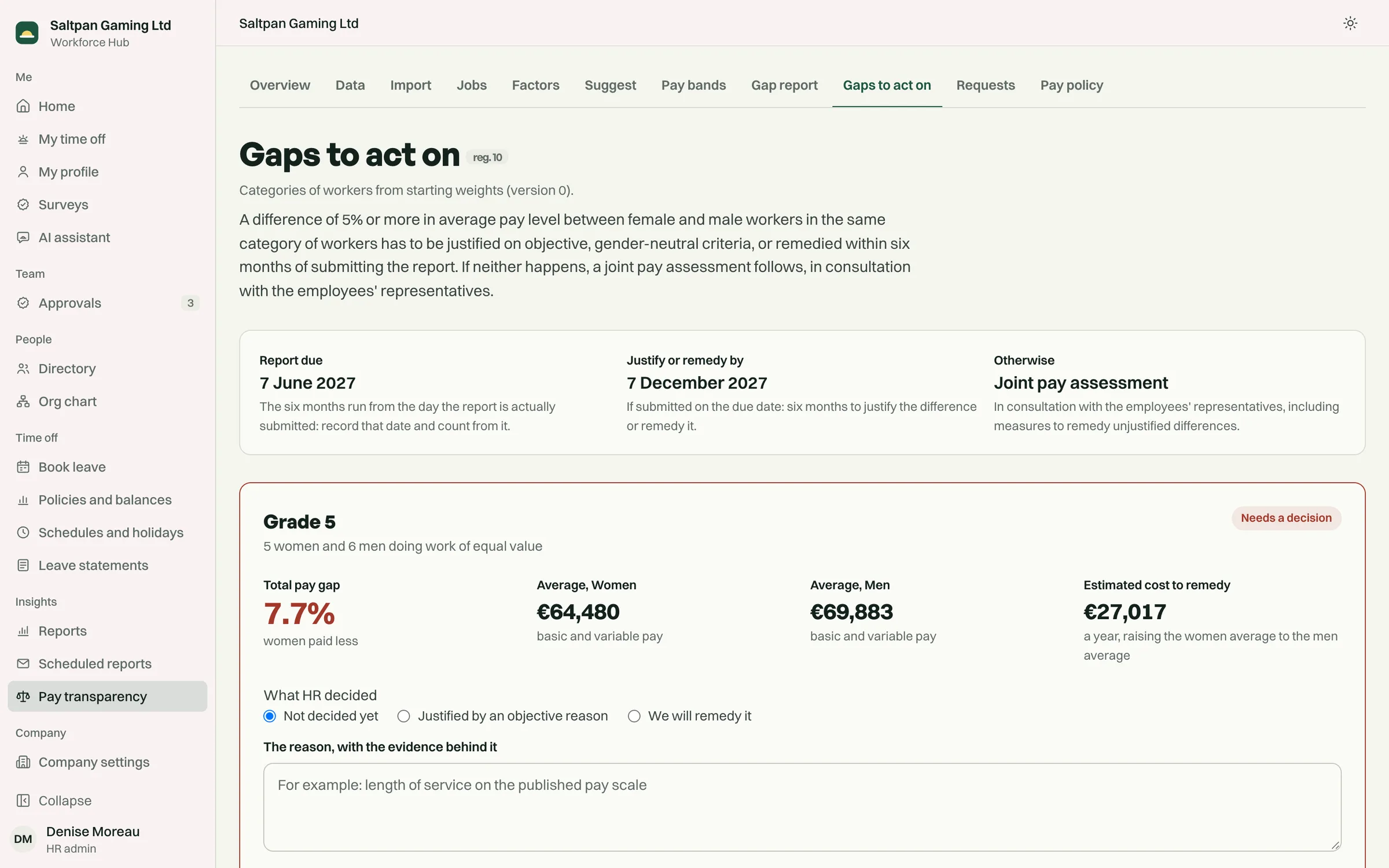
Section titled “Gaps to act on”Any category with a gap of 5% or more, in either direction, is flagged under Article 10. For each one, HR records whether the gap is justified by an objective, gender-neutral reason, or being closed, with the reason or the plan. The six-month date after the report is shown.
The joint pay assessment is drafted per flagged category from the data and HR’s decision. Every decision goes to the activity log with who made it and when.
Pay requests
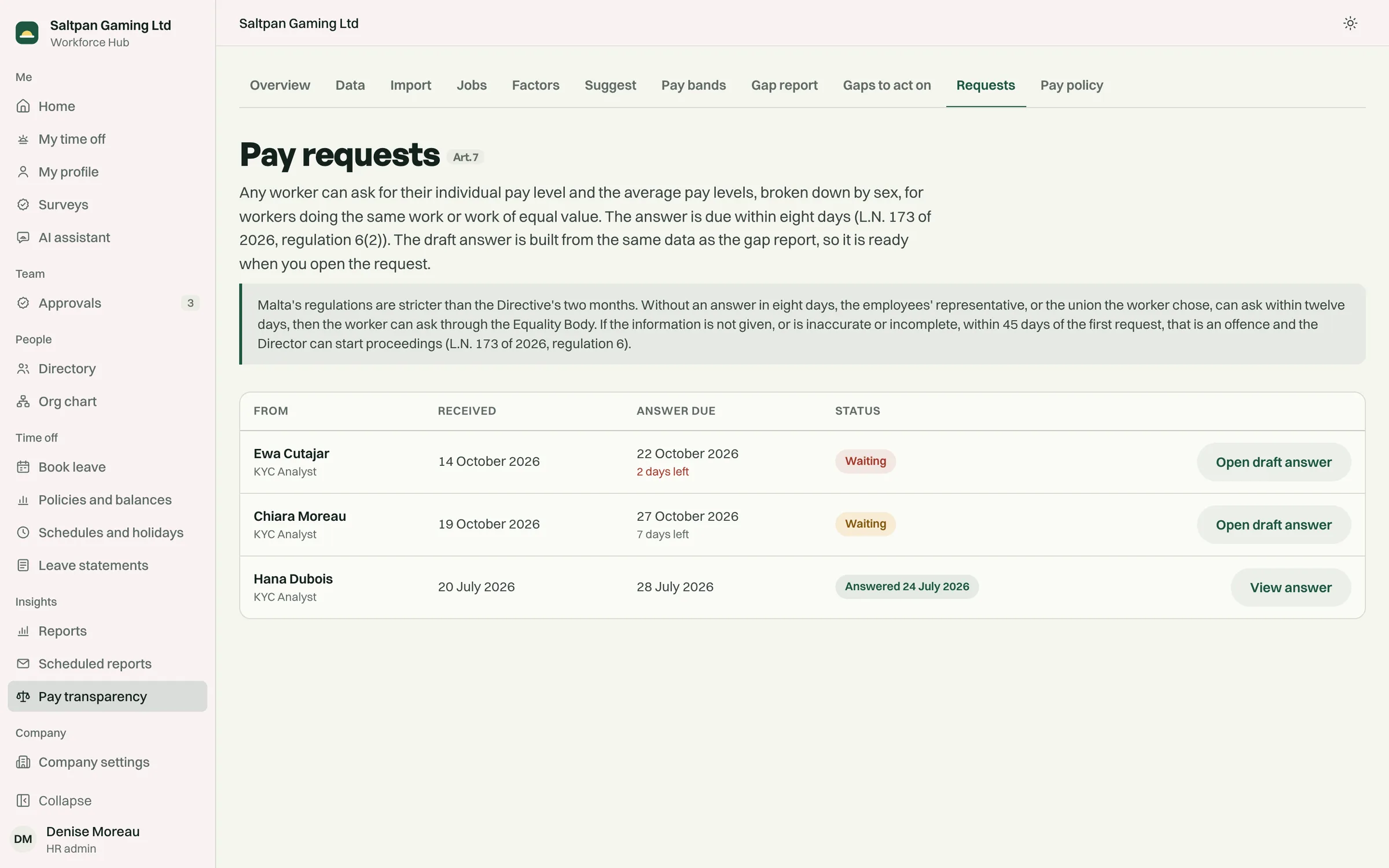
Section titled “Pay requests”Under Article 7, a worker can ask for their own pay level and the average pay of women and men doing the same work or work of equal value.
HR logs each request. The due date follows the governing law in company settings:
- Malta: eight days, under regulation 6(2) of L.N. 173 of 2026. Without an answer, the worker’s representative or union can step in within twelve days, then the Equality Body, and no answer within 45 days of the first request is an offence (regulations 6(3) and 6(5)).
- Elsewhere: two months, under the Directive.
The answer is drafted from the same figures as the gap report: the person’s pay and the averages for women and men in their grade, yearly and hourly, on a full-time basis. It’s drafted by fixed rules, with no model involved, and HR checks it before sending.
Pay policy
Section titled “Pay policy”Pay policy sets out the factors and weights, the grades and their pay ranges, and how pay progresses, for HR to print or share. It also carries the yearly notice of the right to ask for pay information.